
Freedom Infrastructure Partners, LLC. Integrity, Service, Excellence. Home
How We Serve · Evidence Over Opinion

Federal Contracting Capture Management

Fractional capture management for contractors and suppliers, from agency forecast and market research through bid/no-bid, teaming, proposal management, and Gold Team review. Every pursuit is governed by documented gates; the client makes every bid, price, and offer decision.

Select any stage on the graphic to see what FIP does there.
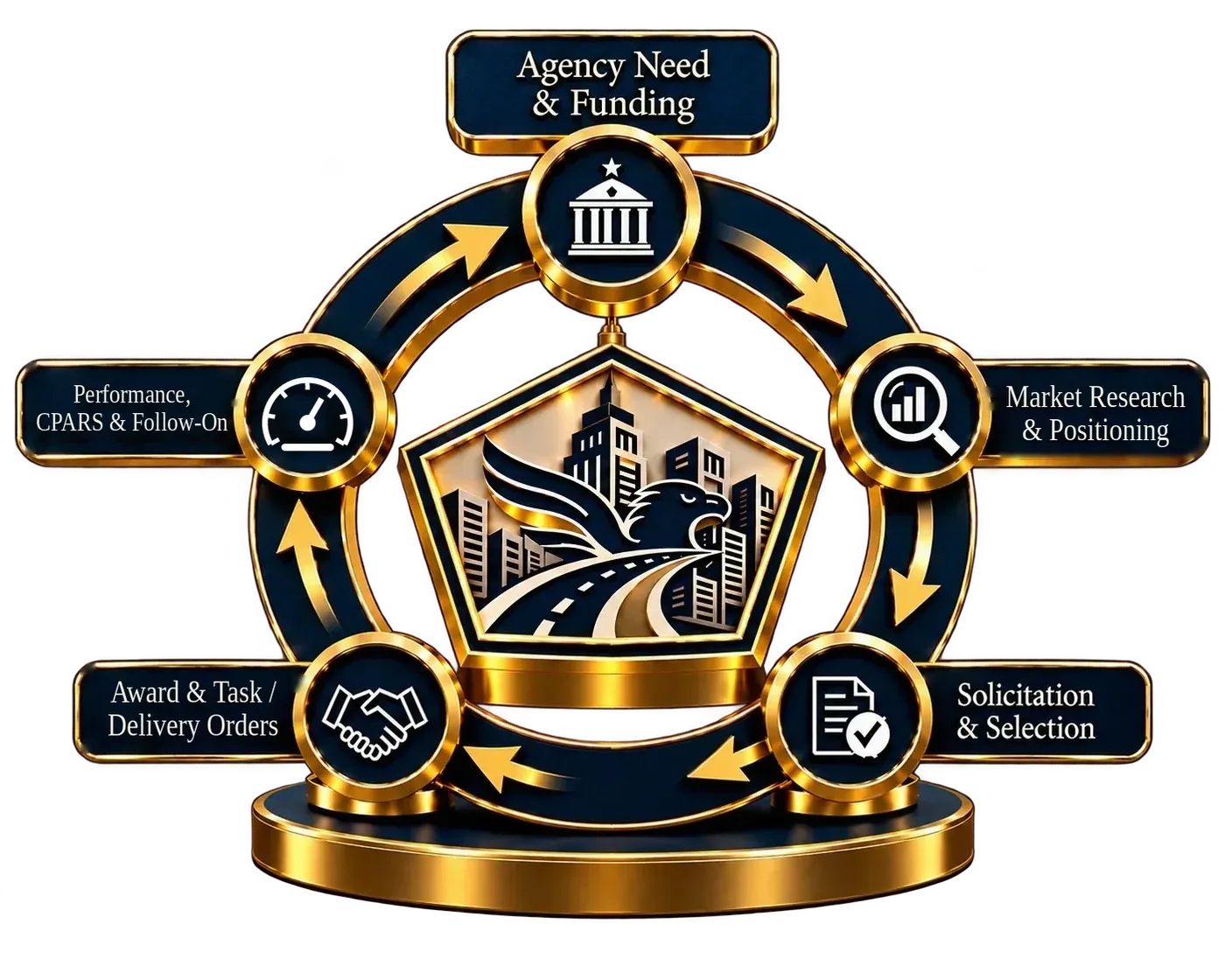
The federal acquisition cycle in five stages: Agency Need and Funding; Market Research and Positioning; Solicitation and Selection; Award and Task or Delivery Orders; and Performance, CPARS and Follow-On, arranged in a gold loop around the FIP emblem.
Stage 1 of 5 · Acquisition Planning

Agency Need & Funding

Agencies define requirements, plan funding, and establish acquisition milestones long before a solicitation is released. FIP finds and qualifies that demand early.

What FIP Does

  • Tracks agency contracting forecasts and anticipated requirements by NAICS and PSC
  • Maps requirements to mission need, likely funding, incumbent, buyer, and acquisition route
  • Reviews award history and contract end dates for recompete and follow-on signals
  • Builds a qualified pipeline before final requirements are released

Deliverable: Federal buyer and market map with source evidence for every material claim.

Stage 2 of 5 · Federal Market Research

Market Research & Positioning

Market research is where the Government determines how the requirement can be acquired and which businesses appear capable of performing it.

What FIP Does

  • Develops sources-sought and RFI responses tailored to the requirement
  • Positions capability statements around the Government's stated need
  • Prepares clients for industry days, presolicitation conferences, and small-business meetings
  • Identifies capability, capacity, eligibility, and teaming gaps before the solicitation is final
Stage 3 of 5 · Source Selection

Solicitation & Selection

Once the solicitation is released, the requirement becomes a scored competition. The proposal must make the evaluation easy.

What FIP Does

  • Runs a documented bid/no-bid gate with PWin and written rationale
  • Builds the compliance matrix against solicitation instructions and evaluation factors
  • Develops win themes, discriminators, and an annotated outline
  • Coordinates writing, integration, schedules, and data calls
  • Runs Pink, Red, and Gold Team reviews before submission

The client makes every bid decision, sets every price, and signs every offer.

Stage 4 of 5 · Contract Award

Award & Task / Delivery Orders

Award is the transition from pursuit to performance and, on multiple-award vehicles, often the beginning of future fair-opportunity competitions.

What FIP Does

  • Prepares teams for task- and delivery-order competitions
  • Supports post-award debriefing and captures lessons learned
  • Finalizes compliant subcontract work lanes and flow-down requirements
  • Supports subcontracting-plan goals and eSRS requirements where applicable
Stage 5 of 5 · Contract Administration

Performance, CPARS & Follow-On

Performance creates the evidence used in the next source selection.

What FIP Does

  • Tracks performance against relevant CPARS evaluation areas
  • Prepares for option-period and follow-on decisions
  • Conducts after-action reviews and preserves lessons learned
  • Begins follow-on capture before the next agency market-research cycle
How it starts

The 90-Day Capture Pilot

Days 1-30

Map

Agency forecasts, SAM.gov opportunities, award history, incumbents, buyers, and recompete signals reviewed to establish a qualified pipeline.

Days 31-60

Position

Capability statements, sources-sought and RFI responses, buyer-engagement preparation, partner alignment, and capture plans.

Days 61-90

Pursue

Qualified opportunities taken through bid/no-bid, capture execution, compliance planning, and proposal review as timing permits.

A weekly decision log records opportunity, value, fit, PWin, acquisition route, owner, deadline, next action, and the rationale behind each gate decision.

Gate discipline

Every Pursuit Passes Documented Gates

Qualification → Bid/No-Bid → Proposal Go/No-Go

Each gate records strategic fit, competitive position, teaming requirements, PWin, pursuit cost, schedule, capacity, and risk.

PursueFits, competitive, and worth the B&P investment.
Team FirstCompetitive if a named capability gap is closed.
WatchNot mature enough to spend against yet.
No-BidLogged with its reason so leadership stops spending on it.

A No-Bid is a valid successful decision when it protects B&P resources for a stronger pursuit.

Scope

What's Included

  • Market research and opportunity identification with qualification and documented gate reviews
  • Capture plans with win themes, discriminators, competitive positioning, and action ownership
  • Sources-sought and RFI responses, capability positioning, and Government-engagement preparation
  • Teaming and partner research, diligence, NDA, and teaming-agreement coordination
  • Proposal management, including compliance matrix, annotated outline, schedule, integration, and Pink, Red, and Gold Team reviews
  • Weekly pipeline, decision, deadline, risk, and next-action reporting

FIP is measured on the quality, discipline, and timeliness of the work within our control. Government award decisions remain outside FIP's control, and FIP never promises an award.

How we work

Technology-Enabled Acquisition Intelligence

FIP capture engagements are supported by proprietary acquisition-intelligence and pursuit-management technology that organizes opportunity, buyer, competitive, teaming, gate, proposal, performance, and follow-on evidence so leadership can make documented decisions from early market signal through contract performance.

Independence and conflicts

One Client per Pursuit

For any single solicitation, FIP supports one offeror. We do not hold or move competing offerors' bid or proposal information between clients.

  • Dual roles as advisor and potential teammate are disclosed in writing and separately contracted.
  • No price-to-win analysis where FIP is, or expects to become, a competing offeror.
  • Source-selection information is never sought.
  • The client alone makes its bid decision, establishes its price, and signs its offer.
Contact

Start the Conversation

Tell us about the requirement, portfolio, pursuit, or partnership. We'll start with the problem you are trying to solve.

Rick Willis, Founder & Managing Member · [email protected] · 505-433-0911 · Northwest Arkansas · Nationwide Delivery

Do not submit CUI, source-selection information, contractor bid or proposal information, export-controlled data, passwords, or other sensitive Government information through this form.

Freedom Infrastructure Partners

Who We Serve

Federal Government

  • Department of Veterans Affairs
  • Department of Defense
  • U.S. Army Corps of Engineers
  • General Services Administration
  • Federal real property and facility organizations
  • Other civilian agencies

Public & Institutional Owners

  • State and municipal governments
  • Public works organizations
  • Healthcare systems
  • Universities and institutional owners

Private & Industry

  • Prime contractors
  • Specialty contractors
  • Infrastructure service providers
  • Engineering and technical firms
  • Commercial real estate and facility owners
  • Companies pursuing federal growth